Saturday, August 6, 2011

Saul, the Soldiers and the Servants

Gianni Dagli Orti/CORBIS
Saul’s loss of control over his soldiers was a frequent feature of his account. Before the incident with Jonathan in 1 Samuel 14:45, the distress created by Saul’s rash vow was so great that it drove his soldiers mad with hunger and exhaustion that they “pounced on the plunder and, taking sheep, cattle and calves, they butchered them on the ground and ate them, together with the blood” (verse 32). Fortunately, Saul was able to recover them to their senses and discipline them accordingly (verses 33 to 35).

But the costliest failure to rein his men was during the very important mission to annihilate the Amalekites in 1 Samuel 15. The order was, as we already know by now from several articles we’ve discussed, to “totally destroy everything that belongs to them…not [to] spare them [but] put to death men and women, children and infants, cattle and sheep, camels and donkeys” (verse 3). Saul and his force slew the women, the children, the infants, most of the men except for the Amalekite king Agag, and the weak of the cattle and sheep. Why? Saul explained:

Ultimate Bible Picture Collection
“I went on the mission the Lord assigned me. I completely destroyed the Amalekites and brought back Agag their king. The soldiers took sheep and cattle from the plunder, the best of what was devoted to God, in order to sacrifice them to the Lord your God at Gilgal” (verses 20 and 21).

And in boasting he claimed, “I did obey the Lord” (verse 20).

After this, the Spirit of God departed from Saul, opening him to the attacks of evil spirits. The first one in 1 Samuel 16 haunted and severely terrorized him that paralyzed him from his kingly duties. The fear may have begun to take its toll on his health when this bright idea was suggested by the royal attendants:

SuperStock/Gettyimages
“Saul’s attendants said to him, ‘See an evil spirit from God is tormenting you. Let our lord command his servants here to search for someone who can play the harp. He will play when the evil spirit from God comes upon you, and you will feel better’” (1 Samuel 16:16).

We cannot help but consider the hand of God that the attendants knew exactly what the king needed and whom exactly to turn to:

“One of the servants answered, ‘I have seen a son of Jesse of Bethlehem who knows how to play the harp. He is a brave man and a warrior. He speaks well and is a fine-looking man. And the Lord is with him” (verse 19).

It was as if they were on to David’s Facebook profile, or something! And how about the servant who had something to offer the Seer Samuel for the sake of the lost donkeys? Simple servants whose involvement opened the door to the most monumental chapters of Saul’s life and of the annals of the Israelite nation as well. Usually their roles are unnoticed as they lend support to the all-prominent figures of Saul and David, but many years after they have sank back to obscurity, Israel’s greatest monarch would sing in one of his world famous psalms that he “would rather be a doorkeeper in the house of my God than dwell in the tents of the wickedness” (Psalm 84:10).
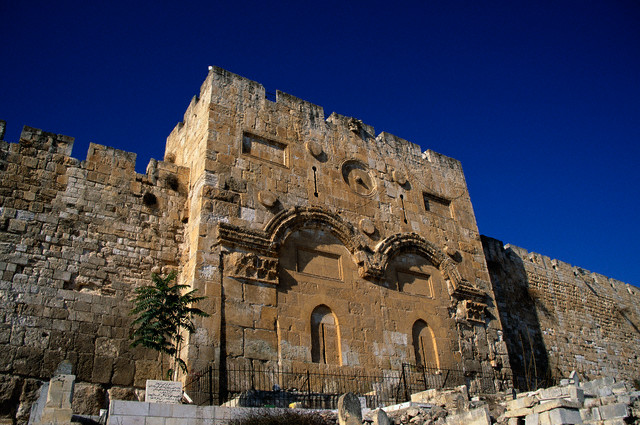
The Golden Gate of the Temple Mount at present time.
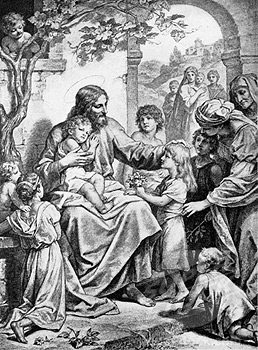
In the ancient world, the youngest child of the family, also called “the least,” received the brunt of all domestic menial work, at a certain point of his life. He was virtually the family servant. He was the one Jesus alluded to when He one day jumped in the middle of an argument among His disciples to settle “who would be the greatest” (Luke 9:46):

Exactostock/SuperStock
“Jesus knowing their thoughts, took a little child and had him stand beside him. Then he said to them, ‘Whoever welcomes this little child in my name welcomes me; and whoever welcomes me welcomes the one who sent me. For he who is least among you all—he is the greatest” (verses 47 to 48).

The message of the “greatest least” became a recurring theme throughout His three-year ministry, telling and showing all Israel that, “If anyone wants to be first, he must be the very last, and the servant of all” (Mark 9:35); and, “…whoever wants to become great among you must be your servant, and whoever wants to be first must be slave of all. For even the Son of Man did not come to be served, but to serve, and to give his life as a ransom for many” (Mark 10:43 to 45).

And the life of a least did His earthly ancestor live his young days, a shepherd of the flocks of his father Jesse (1 Samuel 16:11) until a simple chore brought him to the right place at the right time.

The Bridgeman Art Library/Gettyimages
“Now Jesse said to his son David, ‘Take this ephah of roasted grain and these ten loaves of bread for your brothers and hurry to their camp. Take along these ten cheeses to the commander of their unit. See how your brothers are and bring back some assurance from them.’ Early in the morning David left the flock with a shepherd, loaded up and set out, as Jesse had directed” (1 Samuel 17:17 to 18, 20).

It was the last errand he would ever make. On that day, he singlehandedly shuts the mouth of the Philistine champion permanently and captures the awe of every Israelite, from King Saul to the singing women who celebrated “his tens of thousands” slain (18:7 and 8).

David was introduced into Saul’s life as a servant. He was Saul’s private harpist who performed a very unique form of exorcism by playing his harp (16:18, 23). And it pleased Saul to have him in his court:

Bettmann/CORBIS
“David came to Saul and entered his service. Saul liked him very much, and David became one of his armor bearers. Then Saul sent word to Jesse, saying, “Allow David to remain in my service, for I am pleased with him” (verses 21 to 22).

Saul’s fondness for David would not last, however. Of all Saul’s servants whom he afforded a measure of respect, David was the most loved, the most feared, and the most abused. Shortly after David shot to fame, his popularity galled the king who at once “kept a jealous eye on David” (18:9). With the Spirit of God gone from his life, “an evil spirit from God came forcefully” (verse 10) and possessed him to draw his spear and twice attempt to “pin David to the wall” (verse 11). The twelfth verse explains how fearful Saul grew of David that he promoted him from harp player into a commander over a thousand men who victoriously led the troops in their campaigns (verses 13 and 14) “because the Lord was with him.” For this, there was nothing heard in Israel but David’s fame, and Saul, who wanted nothing more but the adoration of all Israel to ensure his and his posterity’s position on the throne, drove him in an insanity that bordered between the bitterness and fear of his former harpist. His attempts to extinguish the kingdom-wide craze called David went from spearing the boy twice in the privacy of his royal home to putting him in the lead of a thousand-man troop in hopes of getting him killed in battle with the Philistines (verse 17). Saul even went to absurd lengths in deceiving David by maneuvering him “to take revenge on his enemies” (verse 25) and bring back “a hundred Philistine foreskins” (verse 25). David the Circumciser? But even in this seemingly ludicrous quest, “the Lord was with David” (verse 28) and granted him “with more success than the rest of Saul’s officers, and his name became well known” (verse 30).

SuperStock/Gettyimages
Because of David, there were those who would suffer and die. While the Lord covered him in the shelter of His wings during the time when Saul obsessively lusted after his life and pursued him across the Israelite landscape, the little town of Nob would get wiped out in one of Saul’s temper tantrums because he insularly suspected that this humble settlement of priests had set its loyalty on David and not reveal his whereabouts (22:11 to 16). In this episode, the instigator was another servant by the name of Doeg, an Edomite.

Charles & Josette Lenars/CORBIS

Now, if you’ve read Chapter 21, you would probably remember an Edomite by the name of Doeg, who may strike some of us as a weasel, cowardly and shady. He was King Saul’s “head shepherd” (v. 7). It seems that in this chapter, Doeg was given special mention with a standalone paragraph of a verse dedicated to him and what he was doing in Nob:

“Now one of Saul’s servants was there that day, detained before the Lord; he was Doeg the Edomite, Saul’s head shepherd.”

A number of foreigners living in Israel, specifically in royal service, have been mentioned in the Bible; and they have been noted for godly things. Uriah the Hittite in 2 Samuel 11, Bathsheba’s original husband, was among these foreigners whose name has been highly held in the Scriptures. As for Doeg, the Edomite, 1 Samuel 21:7 says that he was “detained before the Lord” the day David visited Nob. What a royal herdsman was “detained before the Lord” at Nob for is yet unclear to us. We can speculate, however, that this foreigner was undergoing ceremonial cleansing proceedings prescribed for aliens living among Law-abiding Israelites. Yet there is a more pressing fact relating to his detention with Nob bearing a massive significance.

Photodisc/Gettyimages
Nob was a levitical city. A city of priests. In Numbers 35, God commanded Moses and the children of Israel to provide cities for Levites where they can live in along with a common land around those cities, “a thousand cubits all around” the city wall (vv. 4–5), that they could raise their livestock. In verse 6, God prescribed six of these towns and cities to be for the purpose of local asylum: “to which a person who has killed someone may flee.” In verse 15, however, God purposed these six points to be “for Israelites, aliens, and any other people living among them, so that anyone who has killed another accidentally can flee there.”

When the time came for the Israelites to appoint the levitical cities of refuge, Nob was not one of them. Joshua 21:17 to 18 enumerates its neighbors—Gibeon, Giba, Anathoth, and Almon—being cities of refuge. But in Numbers 35:6, God also expressed to “give” the Levites “forty-two other towns,” for their herds. It could be that throughout the years, Nob had become an additional satellite refuge of any of the original four mentioned.

SuperStock/Gettyimages
It might also be that Doeg had killed somebody and was seeking asylum in Nob. For such reason, he was “detained.” And while Doeg stayed in Nob, he had the opportunity to witness the entrance of David into the city, speak to the priest Ahimelech, and ask for assistance. Doeg observes how Ahimelech takes the consecrated bread used in holy ceremonies (verses 4–6) and give it to David for consumption; and sees the sword of the Philistine giant Goliath pass into the hands of the young warrior as well (verse 9). Doeg must have thought, “If this were not assistance, I don’t know what is!”

How he found his way into the king’s service is as unclear in the passages as how he coincidentally appeared in Nob at the time David arrived there. It can be assumed that Doeg was carried off as part of the plunder in one of Saul’s operations against Edom, as the one sparsely mentioned in 1 Samuel 14:47, which occurred at the beginning of Saul’s campaign against all of Israel’s “enemies on every side.”

After some days later, Doeg springs out of Nob and is found in King Saul’s presence in chapter 22 verse 9, and successfully raises royal tantrum to a frightening level with his report: “I saw the son of Jesse come to Ahimelech son of Ahitub at Nob. Ahimelech inquired of the Lord for him; he also gave him provisions and the sword of Goliath the Philistine” (verses 9 and 10).

Immediately the king sends for Ahimelech “and his father’s whole family, who were priests at Nob” (verse 11). The last clause, “who were priests at Nob,” is included for a purpose because King Saul orders these people hacked to death in front of him, hacked to death by none other than by the hand of Doeg the squealer. Then the unthinkable takes place:

“Then the king ordered the guards at his side: ‘Turn and kill the priests of the Lord, because they too have sided with David. They knew he was fleeing, yet they did not tell me.’ But the king’s officials were not willing to raise a hand to strike the priests of the Lord. Then the king ordered Doeg, ‘You turn and strike down the priests’” (verse 17 to 18).

In the passage that follows, this idiot did what no Israelite soldier would do. Doeg was an Edomite, a foreign fool who harbored no hesitation in butchering that day all the “eighty-five men” of Ahimelech’s household, including Ahimelech himself.

And as if that were not enough, the paragraph includes the nineteenth verse stating how Doeg in his lonesome, fueled with his berserker’s bloodlust, penetrated deeper into Nob and slaughtered the entire populace—“men and women, its children and infants, and its cattle, donkeys, and sheep”! It comes to show a tradition of rage flowing from the highest point of authority—the king—down to the scum feeding on the soles of royal hierarchy. Though the Israelite guards knew better and did nothing to accomplish the king’s order and lay a strike down the priests of the Lord because of their love for their Israelite way of life, it was no surprise that Doeg the Edomite, who had no regard for and hated Israelite way of life, made good the command.

There is a significant note we need to see here regarding the fulfillment of God’s judgment which He pronounced against the house of Eli, the judge and high priest who raised the boy Samuel in Tabernacle service. A part of the prophecy held that God would “cut short [Eli’s] strength and the strength of [his] father’s house, so that there will not be an old man in [his] family line” (1 Samuel 2:31). The judgment stated:

“Although good will be done to Israel, in your family line there will never be an old man. Everyone of you that I do not cut off from my altar will be spared only to blind your eyes with tears and to grive your heart, and all your descendants will die in the prime of life” (verses 32 to 33).

Ahimelech was a descendant of Eli. His son was Abiathar, Nob’s sole survivor, who “escaped and fled to join David” (1 Samuel 22:20). He successfully caught up with David and reported the massacre. This man went on serve David as high priest (1 Samuel  23:6, 9 to 12), even sharing the position with Zadok (2 Samuel 8:17). Through thick and thin with David Abiathar was faithful (2 Samuel 15:24 to 29). He even went daringly undercover for David during Absalom’s usurpation (2 Samuel 15:34 to 36). His end, however, did not come as pleasant. At the end of David’s reign, he shifted alliances to a usurping prince named Adonijah (1 Kings 1:7,9). But the hand of God was upon another prince, Solomon, who immediately deposes him (1 Kings 2:26, 27, 35), thus ultimately ending Eli’s influence in the priesthood.

But God will not forget Ahimelech. In verse 20, a son of this brave priest named Abiathar, And when he had successfully caught up with this king, Abiathar reported of the massacre. What is more heartbreaking, however, is in verse 22 wherein David said, “That day, when Doeg the Edomite was there, I knew he would be sure to tell Saul. I am responsible for the death of your father’s whole family.” Photo credit: American Colony Photographers/National Geographic Society/Corbis

We cannot help but feel sorry for Abimelech. As readers of a different time and cultures, we view his death as something that had happened needlessly, a result of the senseless rage and paranoia of a demon-minded king. We cannot help but lament for this Old Testament martyr who could have been saved should have David prayed and sought the Lord’s instruction and not merely relied on his own wisdom. But on the other hand, we need to realize that at this point of David’s life, he had nothing but the hand of God as his only guide and shield. Even in his life as a fugitive, the statement in 1 Samuel 18:14 rang true, that, “In everything he did he had great success, because the Lord was with him.” And by the very hand of God, he was led into Nob, not only to be aided, but to be ceremonially consecrated and confirmed as the next king of Israel whose house would “endure forever” (2 Samuel 7:15). What happened in Nob was Abimelech, Eli’s descendant, fed the consecrated bread to David, who in his insistence gave this interesting argument:

“Indeed women have been kept from us, as usual whenever I set out. The men’s things are holy even on missions that are not holy. How much more so today!”

The handing of the consecrated bread over to David from the priest was symbolic of the dismantling of the high priesthood and its surrender to David who represented the real High Priest, soon to emerge from his lineage as God would promise as soon as he assumed kingship:


Marc Garanger/CORBIS
“The Lord declares to you that the Lord himself will establish a house for you: When your days are over and you rest with your fathers, I will raise up your offspring to succeed you, who will come from your own body, and I will establish his kingdom. He is the one who will build a house for my Name, and I will establish the throne of his kingdom forever. I will be his father, and he will be my son. When he does wrong, I will punish him with the rod of men, with floggings inflicted by men. But my love will never be taken away from him, as I took it away from Saul, whom I removed from before you”(2 Samuel 7:11 to 15).

Soon after the consecrated bread was given to David, Abimelech handed David Goliath’s sword, the symbol of David’s greatest victory and Israel’s popular approval of his ascent to national leadership. The house of Eli would faithfully assist David throughout his reign until the end (1 Kings 2:26 to 27).

Then the Prophet Samuel died, and while all Israel mourned for him, Saul mourned for himself. For all his life, he depended on the counsel of this great judge and now that Samuel was dead, the only channel of God’s guidance in his life was cut off (1 Samuel 28:6). For a while he was relatively calm about it but when he caught the sight of the Philistine army assembled at Shunem, he lost all hope of salvation. Thoughts began to run through his mind, and then…

Corbis
“Saul then said to his attendants, ‘Find me a woman who is a medium, so I may go and inquire of her” (verse 7).

There is something we can note from these “attendants.” In 16:15 and 16, they knew exactly what was bothering Saul, they knew exactly what he needed, they knew exactly who to help him, and they knew exactly were to find him. Israelite Facebook, I’d say! Now…

“’There is one in Endor,’ they said” (Ibid.).

Ka-ching! Like I said….

We have studied a lot about that night in Endor—and will study more about it! But what we need to see at this time was the protection Saul gave to the witch who held the door of his fate wider to destruction. Instead of executing sentence to this witch whose trade was outlawed by the Law of Moses, he proposed absolution:

“Saul swore to her by the Lord, ‘As surely as the Lord lives, you will not be punished for this” (1 Samuel 28:10).

At the end of the traumatic séance, Saul made good his promise; and the witch, who now owed her life to her royal client, offered him a little piece of advice: “eat” something (verse 22). Saul listened to the witch.

“He got up from the ground and sat on the couch. The woman had a fattened calf at the house, which she butchered at once. She took some flour, kneaded it and baked bread without yeast. Then she set it before Saul and his men, and they ate. That same night they got up and left” (verse 23 to 25).

The next day, Saul was with a different type of servants: his soldiers, the ones who would not comply with his wishes at all times. And even in defeat and him in the face of death, defiance would yet get the better of his armor-bearer when he was told to run his king through the blade (31:4).

Bettmann/CORBIS
“But his armor-bearer was terrified and would not do it; so Saul took his own sword and fell on it. When the armor-bearer saw that Saul was dead, he too fell on his sword and died with him” (verse 4 and 5).

The soldiers of Saul killed many in their lives, but none in the Scriptures is found that their blades were stained by the blood of their fellow countryman. The armor-bearer chose to stain his blade with his own blood over the guilt of murdering his master.

That was the end of the armor-bearer along with Saul’s three sons, but not Saul. In the first chapter of 2 Samuel, a figure of tattered clothes and with dust on his head came running to David’s camp in Ziklag. He explained that he had “escaped from the Israelite camp” (verse 3), apparently an aide of Saul or one of his soldiers. When asked of his background, the aide explained:


Alessandra Bennedetti/Corbis
“’I am the son of an alien, an Amalekite,’ he answered” (verse 13).

From the very race God ordered wiped out. The death of Saul had finally given testimony of his disobedience.

[More.]


Wednesday, August 3, 2011

Saul and Symbols: The Servants

Brooklyn Museum/Corbis
When God’s presence turned from the crucified Jesus Christ, the anguished cry “Eli, Eli, lama sabachtani?” was heard echoing from the cross. I bet King Saul wailed this same phrase out many times in his private. And just as with Jesus, the cry merely rose and dissipated in the sight of an empty sky. Yet for both these kings, there was, in truth, no need to raise the question, except through despair. They knew exactly why God abandoned them; both, however, for different reasons. With Jesus, it was His obedience; with Saul, disobedience. And in the days that followed after being withdrawn the kingship did Saul’s life plunge into psychological hell.

Brand X Pictures/Gettyimages
The disobedience of Saul stands before a background of irony in that at the beginning of his account, he was one never seen with the slightest thread of rebellion. His first appearance in 1 Samuel 9 presents him as a good son whom his father trusted to find and bring back their lost donkeys (verse 3). Unknowingly, he embarks on a spiritual journey of destiny that leads to the first royal throne of Israel. As he and his servant meandered into Ephraimite territory, it was as if they were bring strung along to cross paths with “a man of God…highly respected” whose every word “comes true” (1 Samuel 9:6). At that moment, Saul’s mission gained a new objective: to seek and consult this “seer” (verse 11). The rest of the story from verses 11 to 19 came like a swift cascade of events as one turn “up the hill to the town” of Zuph (verses 5 and 11) brings him face-to-face with the seer and the offer of kingship (10:1). At this point, God begins to unravel His plan for Saul’s life. Note that God does not reveal His plan for one’s life in an explosion of instant information, but as Proverbs 4:18 explains, “like the first gleam of dawn, shining ever brighter till the full light of day.” It is a condition that requires one to abide in Him in obedience and perseverance through the early steps and stages necessary in the foundation of His design, faithful with the early hints and pieces that build up in time to the perfection of His vision.

Stapleton Collection/Corbis
When God promised to His people the land of Canaan to possess and occupy, He did not supernaturally translate them from the gates of Egypt and into borders of the land flowing with milk and honey. On the contrary, through Moses He guaranteed to “drive out those nations…little by little” (Deuteronomy 7:22). In the rest of the passage, He elaborates: “You will not be allowed to eliminate them all at once, or the wild animals will multiply around you.”

Saul had nothing but questions, inquiries, for this are what his name stood for: literally, “asked.” The Hebrew  shâ’ûl is a past participle of shâ’êl, meaning “to inquire, to request” and to a greater extent, “to demand.” And throughout his account, it is very interesting to note that the most significant milestones of his life were not without the initial insinuation of a servant. And Saul in all these welcomed them.

From the beginning of his story, it was a servant that gave him the idea to consult a seer to help them locate the missing donkeys:

“’Look, in this town there is a man of God; he is highly respected, and everything he says comes true. Let’s go there now. Perhaps he will tell us what way to take’” (1 Samuel 9:7).

Charles O'Rear/CORBIS
It is interesting to note that it was the servant who had something to give and willingly volunteered to give the seer (verse 8). For a moment a thought may jut into a reader mind as to who between Saul and the servant actually owns the donkeys!

“’Look,’ [the servant] said, ‘I have a quarter of a shekel of silver. I will give it to the man of God so that he will tell us what way to take.’”

In 1 Samuel 13:11, Saul admitted that his fear was compounded when he saw his soldiers scattering in panic at the sight of the great Philistine army assembled at Micmash. In other words, he did what everyone else on his side did and, as a result, lost the favor of God and the chance for his name to be established over Israel for all time (verse 13 to 14).


 “Saul replied, ‘When I saw that the men were scattering…I felt compelled to offer the burnt sacrifices’” (1 Samuel 13:11-12).

 In the fourteenth chapter, Saul could do nothing but bend to his soldiers’ protest against Jonathan’s execution.

 “Saul said, ‘May God deal with me, be it ever so severely, if you do not die, Jonathan.’ But the men said to Saul, ‘Should Jonathan die—he who has brought about this great deliverance in Israel? Never! As surely as the Lord lives, not a hair of his head will fall to the ground, for he did this today with God’s help.’ So the men rescued Jonathan, and he was not put to death” (verses 44 to 45).

The soldiers continued to be faithful to Saul, but there was more to lose that day than a moment’s spark of mutiny. Saul was about to take the battle to enemy territory, an act that would significantly neutralize the Philistine military strength to regroup and invade. Instead, “Saul stopped pursuing the Philistines, and they withdrew to their own land” (verse 46). In this context, this is why, “All the days of Saul there was bitter war with the Philistines” (verse 52). The forty-seventh and forty-eighth verses seem to romanticize Saul’s heroic prowess as he “fought against [Israel’s] enemies on every side” (verse 47); that “wherever he turned, he inflicted punishment on them” (Ibid.); and “he fought valiantly and defeated the Amalekites, delivering Israel from the hands of those who had plundered them.” The passages portray the king as a merciless and relentless butcher of pagans. And he should have truly been such. For failing to bring the fight into enemy territory, the Moabites, Ammonites, Edomites, Zobahites, Amalekites, and the Philistines must have been as common as a landscape feature arrayed every now and then taunting Saul with their war chants to engage them on the battlefield.

National Geographic/Gettyimages
Saul never broke the power of Israel’s belligerent neighbors, an ominous indication of the Prophet Samuel’s prophecy coming to past: “…your kingdom will not endure, the Lord has sought out a man after his own heart and appointed him leader of his people, because you have not kept the Lord’s command” (1 Samuel 13:14).

Saul’s loss of control over his soldiers was a frequent feature of his account. Before the incident with Jonathan in 1 Samuel 14:45, the distress created by Saul’s rash vow was so great that it drove his soldiers mad with hunger and exhaustion that they “pounced on the plunder and, taking sheep, cattle and calves, they butchered them on the ground and ate them, together with the blood” (verse 32). Fortunately, Saul was able to recover them to their senses and discipline them accordingly (verses 33 to 35).

Sandro Vannini/CORBIS
But the costliest failure to rein his men was during the very important mission to annihilate the Amalekites in 1 Samuel 15. The order was, as we already know by now from several articles we’ve discussed, to “totally destroy everything that belongs to them…not [to] spare them [but] put to death men and women, children and infants, cattle and sheep, camels and donkeys” (verse 3). Saul and his force slew the women, the children, the infants, most of the men except for the Amalekite king Agag, and the weak of the cattle and sheep. Why? Saul explained:

“I went on the mission the Lord assigned me. I completely destroyed the Amalekites and brought back Agag their king. The soldiers took sheep and cattle from the plunder, the best of what was devoted to God, in order to sacrifice them to the Lord your God at Gilgal” (verses 20 and 21).

And in boasting he claimed, “I did obey the Lord” (verse 20).

[And we ain't done! Stickeround 'coz we ain't done!]

Saturday, July 30, 2011

The Fall of Saul: The Betrayal

Saul was a slave to fear. It was easy for him to wallow in its torment. In 1 Samuel 13:12, panicking at the sight of the Philistine army assembled at Micmash, he was forced to illegally offer the burnt sacrifice only the Prophet Samuel was authorized to offer up to God. It was then on known as the triumph of fear, changing the course of Saul’s life forever. From that point, God merely tolerated Saul as king. The Prophet Samuel was very clear that the next king of Israel would not come from any of Saul’s family.

“You have not kept the command the Lord your God gave you; if you had, he would have established your kingdom over Israel for all time. But now your kingdom will not endure, the Lord has sought out a man after his own heart and appointed him leader of his people, because you have not kept the Lord’s command.”

moodboard/Corbis
What looks like a coincidental pile of rocks to us today is actually what God prescribed to anyone building a monument in Biblical times, particularly in His Name. It could also be similar to the one Saul build in his honor.

At that point, Saul no longer saw any future for him or his posterity to rule the people of God. Saul’s attitude changed from then on. Stripped away of God’s favor, he was left with his pride, his lust for power, and a frightening inability to discipline his vehemence that toggled between fear and rage. As a man who saw no future as God’s former anointed, we can now understand why he had no qualms in disobeying His orders to “totally destroy” the Amalekites (15:3). We can also understand the monument he had set up in his own honor in verse 12. A few years after him, Absalom, a son and usurper to King David’s throne would likewise erect his own monument, officially name it after himself and explain, “I have no son to carry on the memory of my name” (2 Samuel 18:18).

Saul knew what he was doing when he decided to disobey and set up his monument in his honor, and in 1 Samuel 15:15 and 20 to 21, he was ready to defend it before the Prophet Samuel. Saul understood that God was behind his action, a dilemma which could be solved with the sacrifice of some pretty fat sheep and livestock. Through disobedience, Saul snatched back the control of his life from the hands of God. He believed that his survival, most especially his kingship, depended no longer in God, but in himself. That night, the Lord came to confide His grief with the Prophet Samuel: “Saul…has turned away from me” (verse 10). “Turned away” in a word meant “betrayed.”

Judas Iscariot

SuperStock/Corbis
One person who saw no future in an immediate governing authority was Judas Iscariot. Being an apostle of Jesus Christ, he was under the immediate governing authority of the Messiah Himself. And being an apostle, he was among the core of Twelve, out of the multitude, that placed their faith that Jesus was the Christ; and in the event that a falling away would occur due to disbelief that He was the Son of God, the Twelve was expected to remain, such as what happened in John 6:66 to 69.

All of Israel during the oppressive Roman period were desperately anticipating the descent of the Messiah who would finally take His place on David’s throne (Psalm 45:6-7), rule the world with peace (Isaiah 9:6-7), bring in everlasting righteousness (Daniel 9:24), introduce the new covenant between God and Israel (Jeremiah 31:31-34), bring Israel to its rightful place of world power (Isaiah 61:1-2). But when Jesus began teaching about His death (Matthew 16:21, 24-28; 20:17-19; 26:11-12; Mark 8:31; 10:33-34; 14:7-8; Luke 9:22; 18:31-33; John 12:7-8, 23, 28, 35-36), Judas’ anticipation for a glorified Israel systematically crumbled. As a matter of fact, the time when Jesus rebuked Judas for disputing the “waste of perfume” (Mark 14:6) was during one of His teachings about His death:

Bettmann/Corbis
“She did what she could. She poured perfume on my body beforehand to prepare for my burial” (verse 8).

Jesus’ reprimand was a slap to Judas’ face. Yet Jesus never meant to embarrass His erring disciple. Though the story in John 12:4-5 holds that Judas instigated the issue of the “wasted perfume,” the version in Mark 14 notes “some of those who were present” agreeing with Judas to the point of rebuking the woman anointing Jesus with particular harshness. Jesus was not about to have the woman get verbally ripped apart by misguided opinion, so He protects her:

“Leave her alone…. Why are you bothering her? She has done a beautiful thing to me” (Mark 14:6).

Jesus’ counterattack did not single out Judas, but was meant to stop the entire group from castigating the anointing woman, who in John 12:3 was identified as Mary, sister of Lazarus. For Judas, however, it was all personal. Verses 10 to 12 of Mark 14 reveal the weakness of Judas’ personality. In contrast to Simon Peter’s character, Judas was a weakling. Simon Peter received worse rebukes from Jesus in the past—like in Matthew 16:23 where Jesus, looking straight at his face, rebukes away Satan as if the disciple was Satan-possessed with him knowing about it—but, except for the denials on the night of Jesus’ arrest, Simon Peter never sent Jesus to His demise.

Fine Art Photographic Library/Corbis
The night at Bethany where He was anointed with the woman’s oil, was a crucial juncture for both Jesus and Judas. In Mark 14:10, Judas was recounted going to the chief priests “to betray Jesus to them.” The chief priests offered him money (verse 11) upon the consummation of the plot, and Judas joined the team that sought for an opportunity to hand them the Christ (verse 12).

Except in the parts of the gospels where Jesus’ disciples were introduced, Judas’ name was largely associated with money. In a Holy Week teaching entitled “School of the Cross,” Reverend David E. Sumrall of the Cathedral of Praise in Manila, the Philippines, asserted that a betrayal is born out of a perceived need of self-development.

[Just when you thought you've heard the last of ol' Saulster! And there's more! ]

Thursday, July 28, 2011

The Illumination of the Urim and the Thummim

There was only one word to describe the New Testament temple priesthood: dead. Jesus would call them “wicked and adulterous” (Matthew 16:4) in their face. He would even deride them in their fraud when He taught the disciples to “be careful” and “be on…guard against the yeast of the Pharisees and the Sadducees” (verse 6). Jesus, in truth, had a good time slapping them with their own stupidity with such phrases as “you are in error because you do not know the Scriptures” (22:29) and “have you not read what God said to you” (verse 31). In His time, the high priesthood was shared and swapped  between to known men of a single family named Annas (Luke 3:2) and Caiaphas (John 18:13 and 24). Their priesthood was no spiritual force but one political party made fat in Roman cronyism.

National Geographic Society/Corbis
And where were the Urim and the Thummim in all these? In 586 B.C. the Babylonians headed by Nebuchadnezzar trampled over the kingdom of Judah and exiled its people into captivity; and everything they found of treasure, “all articles from the temple of God both large and small” (2 Chronicles 36:18), which meant articles as large as the Ark of the Covenant and those as small as the Urim and the Thummim, were ransacked and carried away by the invaders before or as they tore down the Temple. The Babylonian Captivity ended a great regiment of Temple worship. In Babylonia, Jehovic worshippers had to move on and do away with the Urim and the Thummim, the Ark, the Temple and the Promised Land it stood on. It was in fulfillment of a prophecy made by Jeremiah stating that “’the ark of the covenant of the Lord’…will never enter their minds or be remembered; it will not be missed, nor will another one be made” (Jeremiah 3:16).

Burstein Collection/CORBIS
More than fifty years past and the Jews had given their religion a new look with synagogues, to replace the Temple, and “lengthy prayers” (Luke 20:47) for the ritual sacrifices. The prescribed Mosaic furniture, which became symbols of permanence, became nothing but relics so that when the Jews returning to Jerusalem decided to re-erect the Temple and reestablish its worship, they had to make considerable adjustments to compensate with the missing aspects that had long been lost since the Babylonian Capitivity. The passages of Ezra 2:63 and Nehemiah 7:65 had to deal with the missing Urim and Thummim that the governor, Nehemiah, ordered the descendants of the original priesthood “not to eat any of the most sacred food until there was a priest ministering with the Urim and the Thummim.” As we have already learned, it was through the use of the sacred lots that the priestly duties were delegated.

http://www.brooklynmuseum.org/opencollection
Yet while we never hear of the Ark of the Covenant appearing in the New Testament, the function of the Urim and the Thummim makes a comeback in Luke 1:9 when it sets up a priest named Zechariah, “who belonged to the priestly division of Abijah” (verse 5) to “go into the temple of the Lord and burn incense” (verse 9). This was a very important moment as Zechariah came before an angel of the Lord standing at the right side of the altar personally informing him of the birth of John the Baptist.
At this point we can suspect two scenarios, whether the original Urim and the Thummim were rediscovered after some time around the time the Temple was rebuilt or they were recreated for the sake of their role of bringing the enlightenment of God’s will and in matters of ritual. Yet as far as John the Baptist and Jesus Christ were concerned, the scenarios did not matter. The Temple Nehemiah rebuilt was again to be, in one way or another, phased out, and the Urim and the Thummim were to lose the glow to the role of the Holy Spirit.

Alfredo Dagli Orti/The Art Archive/Corbis
In one way or the other, the Temple Nehemiah rebuilt was again to be phased out. The moment Jesus gave up His Spirit on the cross, the thick beautiful holy Temple veil that shielded the Ark of the Covenant in its chamber was “torn in two from top to bottom” (Matthew 27:51). The significance of this phenomenon revealed the end of the human high priesthood. The Book of Hebrews’ “great high priest” (4:14), Jesus Christ, claimed all functions and fulfillment of every Temple trapping and furniture, from the least to the greatest. Before His death, He pictured the death of His physical body with the destruction of the Temple. Later on, the Apostle Paul would use the analogy of the Temple for the physical body of every believer (1 Corinthians 3:16). But on the other hand, there is a specific prophecy Jesus made that referred to the actual destruction of the Temple of Jerusalem. In Matthew 24 as He and His disciples were storming out of the Temple, He said, “I tell you the truth, not one stone here will be left on another; every one will be thrown down” (Matthew 24:2). In 70 A.D. the Romans did destroy the Temple along with the massacre of 600,000 defenseless Jewish civilians.

Elliot Elliot/Johner Images/Corbis
The Hanukkah menorah is a tradition straight out of the Maccabean  period 167 to 63 B.C., a turbulent period of Jewish history when Greek oppression reached blasphemous extent that King Antiochus IV erected an altar of Zeus in the Temple of God where pigs were ordered sacrificed.

Almost three decades after Ezra successfully led home the second wave of Jewish repatriates from the Persian Empire, the voice of God was never heard, not through His prophets; and His will could never be divined, not even by the Urim and the Thummim. For four hundred years, the entire nation of Israel lived each day like the final moments of Saul: seeking and inquiring of the Lord in vain, answering them not by dreams or Urim or prophets. Because of this the trappings of the Temple lost their appeal to many; and though the furnishings continued to maintain the respect of all Israel, they failed to keep the people’s confidence in the matters of God’s will. It was in this setting that spurred the popularity of the Pharisaic sect and for many to abandon the Temple culture. But there was another sect the rise of which had silently revealed in part to the priest Zechariah; and in this sect would rest the power of the sacred emblems to again unveil the will of God.

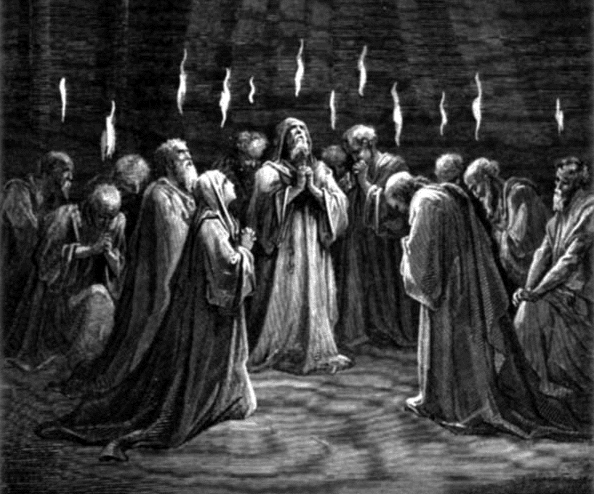
The word urim means “lights,” significant for the illumination that the sacred emblems brought. Urim is also the plural of ur, or flame. On Pentecost the Holy Spirit appeared in the form of “tongues of fire that separated and came to rest on each of” the disciples and the believers who were assembled in prayer (Acts 2:3).

Jesus had explicitly instructed His disciples “not [to] leave Jerusalem, but wait for the gift…promised” (Acts 1:4), by which He meant the baptism of the Holy Spirit (verse 5). Before they ever did anything for God—“preach the good news” (Mark 16:15), “make disciples of all nations, baptizing them in the name of the Father and of the Son and of the Holy Spirit, and teaching them to obey everything” Jesus had commanded them (Matthew 28:19)—the disciples had to be first empowered by the Holy Spirit. There was, however, one thing they carried out before the awaited event. It was to fulfill the prophecy in Psalm 109:8 about filling the place of leadership vacated by the fallen Judas Iscariot. Because this affair preceded the arrival of God’s promised gift, the eleven apostles had to resort to the Old Testament means they were familiar with: the drawing of lots. These were clearly not the Urim and the Thummim but headed with a prayer and in their divine tradition, the lots, perhaps for the last time, spoke for God:

“Then they prayed, ‘Lord you know everyone’s heart. Show us which of the two you have chosen to take over this apostolic ministry, which Judas left to go where he belongs.’ Then they drew lots, and the lot fell to Matthias; so he was added to the eleven apostles” (Acts 1:24 to 26).

The Urim and the Thummim provided counsel and illumination to matters of the Scripture not easily estimated. This was the role described by Jesus when He spoke to His disciples about the Holy Spirit:

“But the Counselor, the Holy Spirit, whom the Father will send in my name, will teach you all things and will remind you of everything I have said to you” (John 15:26).

The Spirit behind the emblems took the place of the emblems as they faded from the Scriptures after their memory was used to divine the next apostle after Judas. From then on the Spirit went with the believers wherever they were. This was the confidence Jesus conveyed to His disciples when He advised them “not [to] worry about what to say or how to say it,” (Matthew 10:19) for “at that time you will be given what to say, for it will not be you speaking, but the Spirit of your Father speaking through you” (verse 20). When in the Old Testament, the wisdom of the lots passed through the hands of the high priest, all the New Testament believer has to do is to “ask” (Matthew 7:7). By the inspiration of the Holy Spirit, James the brother of Jesus exhorted the believers, “If any of you lacks wisdom, he should ask God, who gives generously to all without finding fault, and it will be given to him” (James 1:5). The wisdom that God provided no longer needed to be coursed through a pair of tumbling stones.

Brooklyn Museum/Corbis

In the Old Testament the illumination brought by the Urim and the Thummim served as the counsel that God promised to lavish on all His children. The sacred stones were meant to reinforce His Law, never to violate it. It was meant to complete whatever the Law may have missed out in details, as far as the human intellect was concerned. Thummim means “perfections,” a guarantee of the complete truth that united both God and man (John 4:23 and 24). Again, with truth, we cannot help but be pointed to the Holy Spirit, whom Jesus called the Spirit of truth (John 14:16, 16:13). Yet in every detail, Jesus, in His life and words, was a vast free-flowing river of truth whose refreshing waters were everyday flocked by hundreds of thirsty shepherdless sheep seeking their way home. Jesus Himself introduced Himself as “the way, the truth and the life” (John 14:6).

Francis G. Mayer/Corbis

In His memorable mountainside teaching, He said, “Do no think that I have come to abolish the Law or the Prophets; I have not come to abolish them but to fulfill them” (Matthew 5:17). Jesus, like the Urim and the Thummim, did not introduce a new idea but to complete the demands of the Law. He was God’s perfect sacrifice (Exodus 12:5) who came to complete the Law. The very Person who came take the place of the sacred lots was the will behind the lots: God Himself by His Holy Spirit.

Wednesday, July 27, 2011

Urim and Thummim: The Hands that Hold

http://symboldictionary.net
The One Who Wore the Ephod Wielded the Lots

In the Bible, the high priest donned several ordained garment pieces, and one of these was the ephod. According to Exodus 28, the ephod was generally a linen mantel which the priest wore over him like a shirt, worked with “gold, blue, purple and scarlet yarn” (verse 6); had two shoulder pieces to ensure proper fitting (verse 7); and a waistband—two strips of the same fabric of the mantel extending somewhere from the lower corners of either the front flap or the back flap of the garment (verse 8). In all, the ephod was a single piece of no separate accessories (ibid).

Then the ninth verse features an important element that made the ephod an indispensable symbol of service. God orders two “memorial stones” (verse 12) of onyx (verse 9) bearing “names of the sons of Israel” on both.

“In the order of birth—six names on one stone and the remaining six on the other” (verses 9 to 10).

God deeply involves Himself in planning the intricate elegance of these pieces, in verse 11, and orders them to be fastened upon the shoulder pieces (verse 12) by “two braided chains of pure gold, like a rope” (verse 14).

Some experts believe that these memorial stones of onyx were the Urim and the Thummim. In certain passages above, the ephod, not the breastpiece, was present when an inquiry was made to the Lord.

In 1 Samuel 14:18 and 19 and verses 36 to 42, it was a king stipulating the method of the emblems. In referring to Exodus 28:30, however, the handling of the pair was solely ascribed to the high priest—“Aaron will always bear the means of making decisions for the Israelites…” and note the closing phrase, “before the Lord.” Saul met the “before-the-Lord” part, for he “prayed to the Lord, the God of Israel” (1 Samuel 14:41); and though there is no explicit indication, he undoubtedly allowed the acting high priest Ahijah (in verse 3, he was wearing an ephod, a high priestly garment) to manipulate the lot. The involvement of King Saul, nevertheless, dominated the implementation. Was this legit?

During the time of Joshua’s commission as Moses’ successor, Eleazar the high priest was given the complete freedom to “obtain decisions” for Joshua “by inquiring of the Urim before the Lord” (Numbers 27:21). The God Himself provided this sanction on the sacred divining method:

“This is how Joshua and the rest of the community of Israel will determine everything they should do” (New Living Translation).

The most important element of officiating the Urim and the Thummim is that it must be presided over by the high priest, like a judge today chairing over a courtroom. Back then, an individual with a query came before the high priest and briefly expressed his concern. The high priest then turned to God, whose presence by that time manifested in the form of a radiant light, known in Hebrew as the Shekinah, or the manifest glory of God’s presence. In this presence, with the Urim and the Thummim in his possession, he presented the problem to God and gained His answer through the sacred lots. Needless to say, the one inquiring had to meet the high priest in a non-sanctified location, like the Tabernacle courtyard, where the clergy and the common people converged. After this, the high priest withdrew into a secluded chamber to cast the lots. This was on account of the Shekinah. Although God revealed Himself through this theophany for all the Israelites to behold, no one, but the high priest or Moses, was allowed to approach the Shekinah in the dread of instantaneous death.

Yet in the incident with Saul’s rash vow in 1 Samuel 14:41 to 42, the proceeding was successful in spite of his involvement. An explanation for this takes us back to the third chapter of 1 Samuel where God loses respect for Eli the high priest (verses 11 to 14). After his death, God diminishes the role of the high priest. An evidence of this is presented in 10:9 to 27 and 11:12 to 15, during Saul’s inauguration as king when it was the Prophet Samuel who inducted him and not the high priest. By this time, the last known high priest was Eli who had by then died, thus explaining why there was no high priest present in Saul’s initiation rites. It was very much unlike in Numbers 27:21 where the Prophet Moses and Aaron the high priest had their roles in installing Joshua as Israel’s leader. In the relegation of the role of the high priest, the stewardship of the Urim and the Thummim passed to a lower priest delegated in wearing the ephod.

The Role of the Lots Was to Bring God Closer to His People

Known not to anyone in the kingdom, there was a bigger plan unfolding that came with the dismantling of the high priesthood, the institution of the Israelite monarchial system, and the deputation regarding the Urim and the Thummim. It was a plan of God to bring Him closer to His people. From the time God created man, it has been His expressed desire to commune with someone who bears His image and His likeness (Genesis 1:26). From the time He created Adam, He proceeded to create a house with Adam as its head. Now that house has grown into a nation, a nation which He named Israel. And through the ages, God had been gradually advancing His desire to dwell among His people. From Israel’s wandering days, God said:

http://www.revelationillustrated.com
“Then have them make a sanctuary for me, and I will dwell among them” (Exodus 25:8).


Then, again in 29:45 to 46, after promising the Tent of Meeting, the altar of sacrifice, and Aaron and his children to serve as priests: “Then I will dwell among the Israelites and be their God. They will know that I am the Lord their God, who brought them out of Egypt so that I might dwell among them.” In blessing the tribes, Moses sang: “Let the beloved of the Lord rest secure in him, for he shields him all day long, and the one the Lord loves rests between his shoulders” (33:12).


God Himself described the mode of how He resided during the desert wandering days in 2 Samuel 6:6 and 7:

“I have not dwelt in a house from the day I brought the Israelites up out of Egypt to this day. I have been moving from place to place with a tent as my dwelling. Whenever I have moved with all the Israelites, did I ever say to any of their rulers who I commanded to shepherd my people Israel, ‘Why have you not built me a house of cedar?’”

But even before the Hebrews left Egypt, long before Jacob ever entered Egypt, “God spoke to Israel in a vision at night and said…’Do not be afraid to go down to Egypt…. I will go down to Egypt with you, and I will surely bring you back again’” (Genesis 46:2, 3, and 4). It was not by accident or against the will of God that Israel floundered into Egypt; God Himself went with Israel into the Land of Ra. Four hundred years later, God was with the Israelite nation when they emerged from Egyptian bondage, leading the way:

“See, I am sending an angel ahead of you to guard you along the way and to bring you to the place I have prepared. My angel will go ahead of you and bring you into the land of the Amorites, Hittites, Perizzites,Canaanites, Hivites and Jebusites, and I will wipe them out.” (Exodus 23:20, 23).

Now make no mistake that the “angel” mentioned here was no ordinary member of the heavenly army but Jesus Christ pre-incarnate Himself. In the Old Testament, the term “angel” was used for a heavenly being that appeared in the likeness of a man. Keep in mind that no angel is entitled to or even deserves worship; the angel in this passage, however, does:

“Pay attention to him and listen to what he says. Do not rebel against him; he will not forgive your rebellion, since my name is in him. If you listen carefully to what he says and do all that I say, I will be an enemy to your enemies and will oppose those who oppose you.”

God’s strict and lavish endorsement of this angel can be found in the New Testament when Jesus emerged from the waters of baptism with the sight of heaven opening, the Spirit of God descending like a dove and shining over Him with a heavenly voice saying, “This is my Son, whom I love; with him I am well pleased” (Matthew 3:16 to 17; Mark 1:10 to 12; Luke 3:22; John 1:32 to 34). Another revealing proclamation was during the night of Jesus’ transfiguration when God says, “This is my Son, whom I love; with him I am well pleased. Listen to him!”(Matthew 17:5; Mark 9:7; Luke 9:35)

SuperStock/Gettyimages
And with Jesus in the picture, a prophecy made hundreds of years before Him called Him “Immanuel” (Isaiah 7:14).

Now the Urim and the Thummim were devices used to know the will of God, and any individual in need of consultation came to the high priest as sanctioned by God, in Numbers 27:21:

“This is how Joshua and the rest of the community of Israel will determine everything they should do” (New Living Translation).

But there was the problem: it was only the Joshuas of the Israelite community availing of the opportunity to consult. With only the high-profile figures of the nation approaching the Urim and the Thummim, it seemed like the system was bordered by an exclusive clientele. And because God chose to be a part of the community, He was not about to distance “the rest of the community of Israel” from His will behind layers of leadership and a possible labyrinth of little laws that may evolve. The One True Head of the Israelite Theocracy had to clip away some red tape. And one of the primary tasks in leadership streamlining is to pinpoint obsolete, nonfunctioning, or malfunctioning agencies and policies that cannot be saved and are considered dead weights in the system. God did not have to look far.

The Dismantling of the High Priesthood

For two hundred years since its institution, the high priesthood had been stained with abuse. Its very first priest was guilty of establishing a short-lived Cult of the Golden Calf right at the foot of Mount Sinai even while the summit was obscured by menacing black clouds laced with thunder and lightning that cloaked the conference between God and Moses. Aaron knew that God and his brother were up there; neither was it a mystery to the entire Israelite community. They just were not sure whether the only human in that convention was still alive!

“When the people saw that Moses was so long in coming down from the mountain, they gathered around Aaron and said, ‘Come, make us gods who will go before us. As for this fellow Moses who brought us up out of Egypt, we don’t know what has happened to him’” (Exodus 32:1).

God and Aaron

Design Pics/Darren Greenwood/Gettyimages
God had special plans for Aaron. Aaron was gifted with a special charisma of eloquence worthy of leadership position. During the last days of the Hebrew’s Egyptian bondage, Aaron was with Moses giving his younger brother a boost in expressing God’s command to the Pharaoh:

“…your brother Aaron will be your prophet. You are to say everything I command you, and your
brother Aaron is to tell Pharaoh to let the Israelites go out of his country”
(7:1 to 2).

We never find any account of Aaron protesting or revising God’s words. He was true to his task of being the divine mouthpiece, the “prophet.” Because of this, God never forgot Aaron. On the third month after leaving Egypt (Exodus 19:1), as they beheld trembling at the spectacular sight of God’s majesty descending on the peak of Mount Sinai, God commanded Moses: “God down and bring Aaron up with you” (verse 24). Though Moses alone approached God in all His glory (24:2), Aaron, his sons, and the seventy elders of Israel were also privileged to behold God (verses 9 and 10). They even noted the ground He stood on transform into a “pavement made of sapphire, clear as the sky itself” (verse 10). What joy must have it been for these personalities to have not only stood in the overpowering presence of the Almighty God, who “did not raise his hand against these leaders of the Israelites,” but also eat and drink (verse 11)—for six days (verse 15)! On the seventh day, the Lord “called to Moses from within the cloud” (ibid.) to hand the “tablets of stone, with the law and commands [God had] written for [the Israelites’] instruction” (verse 12).  Moses, in his absence, entrusted community leadership to “Aaron and Hur” (verse 14).

But to think that all the wonder and amazement witnessed in fear and trembling will have its in-stopping effect is to underestimate the enslaving influence of sin over the human flesh. Forty days and forty nights without Moses drained all the respect for the God of Sinai. And Aaron, being a leader who was supposed to use his God-given eloquence and authority to bring the community to its spiritual senses, well, here’s what happened—exactly:

“Aaron answered them, ‘Take off the gold earrings that your wives, your sons and your daughters are wearing, and bring them to me.’ So all the people took off their earrings and brought them to Aaron. He took what they handed him and made it into an idol cast in the shape of a calf, fashioning it with a tool. Then they said, ‘These are your gods, O Israel, who brought you up out of Egypt.’ When Aaron saw this, he built an altar in front of the calf and announced, ‘Tomorrow there will be festival to the Lord.’ So the next day the people rose early and sacrificed burnt offerings and presented fellowship offerings. Afterward they sat down to eat and drink and got up to indulge in revelry” (32:2 to 6).

SuperStock/Gettyimages
Except for the golden idol and the debauchery implied in the passage, the Israelites could have chosen to party instead of cowering in the presence of God while He stood in a pillar of dark cloud with pealing thunder and flashing lightning. As long as they were within limits from the mountain, they could have eaten and drunk as the contingent of leaders called forth by the Lord. It could have been wonderful to have matched the noise of the heavenly clash with the sound of rejoicing from the Israelite camp—of which they were capable to produce! In verse 17, Joshua, from far up the Sinai Mount, could hear the strain of singing from the Israelite camp that he almost mistook for reverberations of war, either of victory or defeat (verse 18).

Moses descends from Sinai, catches the people in the act, automatically gets ticked off and not only breaks the tablets of God’s law in his hands but takes the community calf of gold, burns it, grinds it to powder, creates a solution out of it, has all the people drink it, and then confronts Aaron. Aaron’s defense proved nothing more than ridiculous:

“’Do not be angry, my lord,’ Aaron answered. ‘ You know how prone these people are to evil. They said to me ‘Make us gods who will go before us. As for this fellow Moses who brought us up out of Egypt, we don’t know what has happened to him.’ So I told them, ‘Whoever has any gold jewelry, take it off.’ Then they gave me the gold, and I threw it into the fire, and out came this calf!’” (verses 22 to 24).

 And this was the man who would later be entrusted the Urim and the Thummim (28:30). Why he nevertheless goes on to become Israel’s first Mosaic high priest can only be explained in the light of God’s mercy.

The Troubled Priesthood

SuperStock/Gettyimages
The high priesthood, and its lower hierarchy as well, had its shortcomings, shortcomings that were nevertheless understood by God and were worked around by specific regulations He imposed in the Law given to Moses. All that was therefore needed was a willing heart, seasoned and disciplined in His fear, to carry out these regulations with the strictest care in the desire of God to dwell with His people. But alas, flesh is flesh, and the Apostle Paul’s remark regarding the corruption of the carnal human will always be true to its plainest:

“I know nothing good lives in me, that is, in my sinful nature. For I have the desire to do what is good, but I cannot carry it out. For what I do is not the good I want to do; no, the evil I do not want to do—this I keep doing” (Romans 7:18-19).

But the Apostle’s dissertation does not end there. In the last verse of the seventh chapter of Romans, he could not just wait to burst out in praise: “Thanks be to God—through Jesus Christ our Lord!” And as if in continuation in another epistle, he states: “Though outwardly we are wasting away, yet inwardly we are being renewed day by day” (2 Corinthians 4:16). What the Apostle was pointing out was the trust God has continued to lavish on His earthly children—the salvation provided by the death and resurrection of Jesus Christ. And in Hebrews 4:14, he proclaims Jesus as our “great high priest,” One who is “not…unable to sympathize with our weaknesses [which includes the limitation of our corruption], but we have one who has been tempted in every way, just as we are—yet without sin” (verse 14 to 15).

This is the reason why God was so strict in upholding the Old Testament high priesthood. This is why God never tolerated the willful sins of Nadab and Abihu by consuming them with fire out of His Presence (Leviticus 10:1 to 2). God held great respect for the high priesthood, and expected His chosen servants to honor it with the same, for it symbolized the flawless service Jesus Christ would give His life to. Sadly, the high priesthood would not live up to God’s expectation and He would dismantle it after Eli. Eli failed to discipline his sons who, like Nadab and Abihu, corrupted their Tabernacle duties (1 Samuel 2:22 to 25). Because of this, an unnamed prophet proclaimed the Lord’s judgment that ends the earthly high priesthood:

“I will cut short your strength and the strength of your father’s house, so that there will not be an old man in your family line and you will see distress in my dwelling. Although good will be done to Israel, in your family line there will never be an old man. Every one of you that I do not cut off from my altar will be spared only to blind your eyes with tears and to grieve your heart, and all your descendants will die in the prime of life” (1 Samuel 2:31 to 33).
The priests of Nob under the murderous hand of Doeg the Edomite under Saul's sanction.
In 1 Samuel 4:11, Eli’s sons were slain in battle and the Ark of the Covenant they brought was carried away by the Philistines. In 22:18 to 19, the priests who dwelt in the town of Nob were slain by Doeg the Edomite, as ordered by King Saul. And its only survivor, Abiathar, who served faithfully under David’s command (1 Samuel 23:6, 9-12), was finally removed from the priesthood by the newly installed King Solomon for choosing to support David’s usurping son Adonijah (1 Kings 2:26 to 27). In the New Testament, the priesthood was so corrupt that its existence was completely spiritually inconsequential.


There was only one word to describe the New Testament temple priesthood: dead. Jesus would call them “wicked and adulterous” (Matthew 16:4) in their face. He would even deride them in their fraud when He taught the disciples to “be careful” and “be on…guard against the yeast of the Pharisees and the Sadducees” (verse 6). Jesus, in truth, had a good time slapping them with their own stupidity with such phrases as “you are in error because you do not know the Scriptures” (22:29) and “have you not read what God said to you” (verse 31). In His time, the high priesthood was shared and swapped  between to known men of a single family named Annas (Luke 3:2) and Caiaphas (John 18:13 and 24). Their priesthood was no spiritual force but one political party made fat in Roman cronyism.

[Gotta put on the breaks here for a while, folks. Believe me: THERE'S MORE! But not that more, but more nonetheless!]