Before going on and studying the following cases, it is important to keep in mind that all these events were rooted in Saul’s deliberate defiance to Divine instructions and not some simple knee-jerk reaction of one inexperienced neophyte who knew nothing about contingencies. Before the following incidents took place, the Scriptures has clearly outlined Saul being changed by the Spirit of God “into a different person” (1 Samuel 10:6, 9); being charged to “do whatever [his] hand finds to do” because God was already with him (verse 7); and gaining his first glorious victory against the Ammonites in 11:1–11. These challenges were supposed to have prepared him for the succeeding tasks of “establishing [his] kingdom over Israel for all time” (13:13) and carrying out God’s judgment against the Amalekites and wipe them off the face of the planet (15:19).

(Photo credit: 2001 Universal Pictures, from the blockbuster
The Mummy Returns).
Saul's Unlawful Sacrifice in Gilgal (1 Samuel 13:1-15):

In Chapter 13, Saul lost heart after seeing the massive Philistine army preparing to battle his forces, and felt “compelled” to perform a duty that was supposed to be done by Samuel. From a force of “three thousand” (verse 2), it dwindled to “about six hundred” (verse 15) when, in Micmash, they stood before a Philistine force of “three thousand chariots, six thousand charioteers, and soldiers as numerous as the sand of the seashore” (verse 5). For some reason, the Prophet Samuel was delayed for seven days in joining the Israelite force in the battlefield. Because of this, the Israelite army quaked in fear (verse 7) and “began to scatter” (verse 8). But instead of inspiring his men to stand fast because the Lord was with them, he takes matters into his own hands and seeks the favor of the Lord by offering the animals meant for burnt sacrifice because he saw his life flash before his eyes—just as his men reacted—in the sight of the great Philistine army. Very simply put, he started to make peace with God because he was sure to face certain death in the hands of the Philistines.
Saul had forgotten, quickly, how some time ago he saved the city of Jabesh Gilead from the threat of Nahash and his Ammonite army (1 Samuel 11). In this story, the Lord’s Spirit came upon him and the soldiers of Israel came out “as one man” (verse 7) numbering “three hundred thousand,” plus “thirty thousand” more from the immense tribe of Judah (verse 8). The victory was great, as great as the slaughter of the enemy and the retreat of those who survived. This was Saul’s first victory: a victory won with a mighty force. It could have been impressed in Saul’s mind that in addition to the Spirit of God, every battle is won by a large army. In Saul’s carnal understanding, he must have made an imperative connection between God and a mighty army, that He will inspire a statistically superior number of hearts that will overwhelm that of the enemy.
In the standoff a Micmash, an enemy force stood before the Israelite king that at least had the appearance of the same enormity as the one he led in Jabesh Gilead. And then the numerical strength of his army started thinning. Saul feared, his heart buffeted by the currents of terror running through the souls of his men as they took cover from the very sight of the Philistine army. Yet to fear or not to fear and believe the deliverance of God as what was experienced in Jabesh Gilead continued to be main issue here. In Saul’s choice to fear, fall from his faith in the power of God’s deliverance, and forget his victory in Jabesh Gilead, he had lost his God-given authority and privilege to be king. The Prophet Samuel arriving seven days later simply confirmed this (1 Samuel 13:14).
Saul and God’s Judgment on the Amalekites (1 Samuel 15):
Saul’s disobedience to God’s command was legendary. The events in the fifteenth chapter of 1 Samuel ominously foreboded for the king a life of doom and isolation from the presence of God. In verse 11 God openly expressed to the Prophet Samuel that He was grieved to have made Saul king. Saul, despite the fiasco at Micmash and its subsequent incidents, was given the opportunity to make a name for himself by carrying out God’s judgment of wiping out an unrelenting adversary. Saul was commanded to march out against the Amalekites “and totally destroy everything that belongs to them…men, women, children and infants, cattle and sheep, camels and donkeys” (verse 3). It was a judgment borne by love for His people. God’s heart was crushed when the Amalekites “waylaid them as they went up out of Egypt” (verse 2).
Now why did a loving God give such a brutal command? We can trace the story back to Exodus 17:8–15, where the Amalekites became the first people to ever engage the Israelites in open battle. The skirmish bore with it all the elements of a major battle as if the Israelites, in all their inexperience in war, ever decided to face the Egyptian army that pursued them to the coast of the Red Sea. The triumph was not easy: “As long as Moses held up his hands, the Israelites were winning, but whenever he lowered his hands, the Amalekites were winning” (verse 11). The war also proved to be so protracted that Moses found it necessary to fit his arms above two rocks to keep them propped up (verses 11 to 12). It was a war that lasted almost a day. In the end, God gave the Israelites two things: victory (verse 13) and a promise to “completely erase the memory of the Amalekites from under heaven” (verse 14). Down to the last verse of the passage, it seemed that God took a particular hatred of the Amalekites: “The Lord will be at war against the Amalekites from generation to generation” (verse 16).
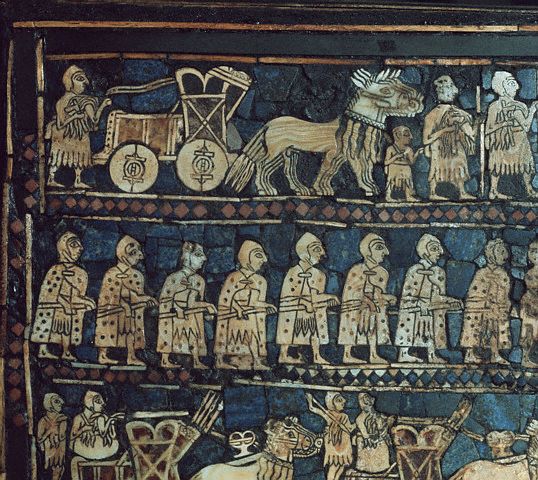
A near eastern army gearing up for battle. (Photo credit: Werner Forman/CORBIS)
And now that Israel had already gained the unified power of all the strength of Israel, it was payback time. God swore by Himself that He would ice these suckers in the past, and even had Moses document this promise “as something to be remembered and make sure that Joshua hears it” (verse 14). Knowing God, He keeps His promises, especially those He makes to Himself (2 Thessalonians 5:24, 2 Timothy 2:13). Yet as in all of God’s judgments, He provides ample time for a people, and a person, to come to repentance until He can no longer endure the cry of the oppressed. Joel 3:13 pictures God’s judgment as that of the time of harvest, when it is “ripe,” when “the press is full, the fats overflow” and “their wickedness is great” (King James Version). This was the very same standard used before judgment fell upon Sodom and Gomorrah in Genesis 18:20. The Amalekites never came to Him in repentance, unlike the people of Nineveh in third chapter of Jonah.
In addition, whenever God sent someone out to war, that one never went alone: he had God with him. In Exodus 14:19 to 20, He was known as “the angel of God” who came “between the armies of Egypt and Israel”; He was “the angel of the Lord” in 3:2 who appeared in the burning bush, and stated “I am the God of you father, the God of Abraham, the God of Isaac, and the God of Jacob” (verse 6), and charged Moses to go to the pharaoh of Egypt and deliver His people. And with this mission He makes a promise: “I will be with you” (verse 12). Hundreds of years later, the young shepherd boy David beautifully and firmly encapsulates the principle: “the battle is the Lord’s” (1 Samuel 17:47). With this in mind, it was God, therefore, going out to war against the Amalekites in what could have been the very last time, and He was as if merely commanding His temporal representative, the king, to go out with Him.
But something unexpected happened. In 1 Samuel 15:7 to 9, Saul suddenly changes his mind. He deliberately seizes the Amalekite king alive along with “everything that was good” (verse 9). In verse 21, Saul even provided an alibi stubbornly justifying his disobedience: “to sacrifice them to the Lord your God.” Then, in the same verse he tries to pass the buck, blaming the soldiers to have taken “sheep and cattle from the plunder, the best of what was devoted to God.” Boy, talk about “letting them have it”; he really “let them have it!” In the last part of verse 25, he finally confesses to the Prophet Samuel: “I was afraid of the people and so I gave in to them.”
"Hey, unhand mine mantle, dude!" A scene after the Prophet Samuel discovered that Saul, "the servant of God," had kept for himself the fat of the Amalekite plunder and preserved the life of the Amalekite king. The prophet warned Saul that God had dethroned him as king. (Photo credit: Bettmann/CORBIS)
God’s hammer and chisel ready to carve a monument for His king should he had carried the most important part of the mission, to “wipe…out” (1 Samuel 15:19) the Amalekites. In verse 12, Saul went to Carmel and “set up a monument in his own honor.” Did Saul think that his strength won him the victory? And as if things could not get more outrageous than it was, he declares and justifies to the Prophet’s Samuel’s face that he “did obey the Lord” (verse 20). The moment Saul became unwilling to slay the Amalekite king and the best of the beasts, He was grieved. The King James Version uses the word “repenteth.” “Repent” is much more than the feeling of guilt and remorse we normally associate it with; it is a word that always entails action. It is the same word used when a sinner makes an ultimate decision to turn away from sin. In the case of the eleventh verse, God made a decision to irrevocably take the kingship away from Saul. It was a decision that Samuel took severely: before he went to meet with Saul, he was troubled and wept all night; after confronting the king, verse 35 said that “he did not go to see Saul again, though Samuel mourned for him.”
Saul succeeded where the Devil had failed, and it took Samuel—the last of the judges—to completely carry out God’s judgment against the Amalekites by slaying Agag the king in verse 33.
Saul was no leader. During his previous encounter with the Philistines, he was reduced to a sniveling coward, and he panicked along with his men. In his campaign against the Amalekites, he too acted as one of the men in willful disobedience to the Lord. He should never have been king.
Saul’s Rash Vow and the Complications Surrounding It:
After quaking in fear at the sight of the massive Philistine army in Micmash, the chance to route them brought Saul into the opposite extreme of bloodlust. Out of his blind rage, he compels his men to agree in oath that no one eats any food until evening before the enemy has been entirely slaughtered. It was a decree that plunged his soldiers “in distress” (1 Samuel 14:24), all the more when they made their way through a forest where honey was all over the floor and oozing out of the trees.
Taking oath was a serious matter in the Israelite culture, unlike today when trust only goes as far as the power of “black-and-white.” In those days, oaths were an important part of human-to-human relationships even permeating business transactions. The legal procedure of property protection holds an important place for the oath (Exodus 22:10–11). God made oaths and kept them: this therefore became the best example for all people to emulate. Today, the swearing-in of witnesses in court is taken lightly. Back in the Israelite days, however, breaking an oath meant certain death, for the realm was ruled in a Theocracy of a living God, not in a democracy of men. When David shouted at Goliath in the battlefield, “there is a God in Israel” (1 Samuel 17:46), he referred to the reality of Divine rulership of his nation in spite of the presence of a human king. And this Divine Ruler oversaw the oaths of every human lips. Therefore: “When a man makes a vow to the Lord or takes an oath to obligate himself by a pledge, he must not break his word but must do everything he said” (Numbers 30:2); “if a person thoughtlessly takes an oath to do anything, whether good or evil—in any matter one might carelessly swear about—even though he is unaware of it, in any case when he learns of it he will be guilty” (Leviticus 5:4).
Jonathan, however, rejoining the pursuit after going commando earlier, had not known about the oath and took the liberty of partake of the sweet snack offered by the forest. According to Divine Israelite law, ignorance of an oath excuses no one (Leviticus 5:4), and Jonathan shatters the army’s collective oath to fast. This led to the silence of God when Saul went to inquire of Him whether to pursue the Philistines any further.
Saul’s imprudence in forcing his men to strike an oath at a very inauspicious time takes top responsibility of this situation. There was always an opportunity to methodically set the circumstances in a more favorable order for the oath to have been taken. But because his men were enfeebled and hungry, and seeing the example set by Jonathan—who even counter-supports his guilt with an alibi (verses 29–31)—the resulting violation of the oath was compounded with another infraction. In verse 32, the entire army went into a feeding frenzy over their plunder of sheep and cattle and gorged on them with the blood still in the meat.
When Saul was told of the development, he goes on to greater indiscretion. In verse 39, he promises death to anyone proven to have rooted the guilt of sin in his ranks, even if it lay with his son Jonathan. In the Bible, when one used the phrase “As surely as the Lord lives…” the condition that followed was a unambiguous vow. In verse 42, his confidence of innocence was confounded when he finds out, by drawing lots, that the guilt fell on Jonathan. So then. Was Jonathan executed as promised?
In the Bible, when someone used the introductory “May God deal with me, be it ever so severely,” the next phrase about a course of action was another vow more certain to be carried out. And with Saul in all the fury of hell declared death to his son before him (verse 44). Should have Saul slain Jonathan that day, the guilt would have been lifted; God would have responded to Saul’s inquiry whether to attack the Philistines “by night and plunder them till dawn, and…not leave one of them alive” (verse 36). Saul’s kingdom would have been established deeper than it ever was.
But in the way he buckled under pressure in the presence of his men in Micmash, so he does in their heated protest when they stood in defense of Jonathan (verse 45). This ended Saul’s march against the Philistines that day. It also marked the limit of the power of his kingdom as seen by the Prophet Samuel after he lamented of Saul’s cowardice in Micmash: “You have not kept the command the Lord your God gave you; if you had, he would have established your kingdom over Israel for all time. But now your kingdom will not endure” (13:13–14). Noted in 14:52 is the constant struggle Saul had with the Philistines, unlike in the time of David when they were greatly dispossessed of cities and towns (1 Chronicles 18:1), and further during Solomon’s reign (2 Chronicles 9:26).
Next: Saul goes over the edge with the witch of Endor.